Wednesday, October 01, 2008

Squirrelly Business


I'm from Utah originally, so the only time I ever saw squirrels was on camping trips into the wild where their adorable scampering became synonymous with happy, holy nature. When I started school at Bryn Mawr College out on this end of the country, I was amazed at the hundreds of squirrels around, doing their adorable scampering business all over the lawns of my new school. I said to my friends, "Look at all the squirrels! Aren't they so cute? I just love all the squirrels here!"

Of course, they all looked at me like I had developed instant leprosy and were likely also wondering if I had a possible malignant brain tumor to boot. (I had a similar experience once--on the giving end--when my friend Miriam commented out loud how cute she thought cows were. I think we were watching some TV program. I asked her, "Have you actually SEEN a cow in real life?" She admitted that she hadn't. I told her I would give her a tour of their fetid stinky "cuteness" next time she visited me out in rural northern Utah).

The truth is, squirrels are the rats of New Jersey (though, don't get me wrong, we have rats here, too. They are, however, surprisingly less annoying than squirrels). Ah, yes, they are fuzzy-tailed, light-footed bundles of cuddliness, but there's a reason they are all over people's lawns and trees. They are not there to pose for pictures. They are little anarchists. They do not acknowledge your property rights.

More frankly, your house. Come winter-time, squirrels like to nest in hollow trees which are dry and cozy. Your attic is the biggest, nicest hollow tree a squirrel has ever laid eyes on. Your attic is the holy grail of hollow trees. It is not just cozy: it has its own heat source. It's as warm as summertime in there! And spacious, too. This Jersey rat has just landed the squirrel-equivalent of a New York City penthouse. 

And just like a new and annoying young Hollywood starlet occupying said penthouse, it doesn't know the meaning of "bedtime". In fact, that's when the party is just getting started. It's up there, with its little squirrel friends and its squirrel catering service, and just possibly its hordes of squirrel offspring, at all hours of the night scampering here and scampering there, making sure everyone is having a good time and there's enough squirrel drink to go around, while the crotchety old neighbors downstairs (us!) are trying to get some badly needed rest. Banging on the ceiling will cause everything to go quiet for a few seconds, but soon enough, the party starts right back up again and this time, there are no squirrel police you can call about noise violations.

As you may have determined, we currently have a squirrel in our attic. It arrives around 7 pm, just as darkness is setting in and leaves again around 7 am when Nate is heading to work. Attempts to scare it into leaving, such as screaming, stomping, banging, and sticking squirrel dolls with pins, have done nothing other than turn us into screaming, stomping, banging, voodoo'ing lunatics. The squirrel is quite content to live above such chaos. Meanwhile, I had to sleep yesterday with earplugs in, which was great for not hearing the squirrel all night long, but also meant if my children were screaming bloody murder for their mommy, I missed that, too. 

Tonight, Dave, our handyman, is coming by to look for holes in the roof where our squirrel starlet squatter is getting in and tomorrow an exterminator will be coming to live trap the creature and cart it off to someone else's backyard. Hopefully that will be the end of it.

We'll see.


Tuesday, September 30, 2008

Thomism

Thomas is home from school today and so I laxed a pretty solid house rule of no TV in the morning. He reminded me just how lax when he said, "Mommy, my TV brain is still watching TV!" after I told him a few times that he ought to turn it off.

Well, I finally came down hard: "TURN IT OFF NOW."

To which Thomas replied, "But mommy, if I turn it off, my TV brain will smack me!"

Monday, September 29, 2008

Reading Comprehension Quiz


Instructions: Read the following passage, then answer the questions below. 

Once upon a time, there was a mother who had eight children. The youngest was a little boy, toe-headed and slate blue-eyed, who seemed destined for greatness. As a child, he listened faithfully to the news on his radio and thought deeply about the problems of the world. Astounded adults would ask him questions about Russian and American politics which he could answer in great detail. In first grade, he complained that there was no discussion of negative numbers and as a third-grader, he read The Rise and Fall of the Third Reich. He drew detailed pictures of Russian aircraft, contemplated the horrors of nuclear fallout in a Cold War era, and wrote a poem entitled, "Where does the sky end?" which won an Honorable Mention in the annual Reflections contest.

Of course, the little boy grew up to be a great man who became schooled in all the hard sciences--Mathematics, Chemistry, Physics, Pharmacology--as well as the liberal humanities of Rhetoric (Business Administration) and Law. But while work, study, and learning have required most of his time, he invests all of his emotional energies in an even higher calling: husband and father. As a result of both his accomplishments and his intense familial devotion, he is loved and admired by all who know him.

Questions:
1) Who is the person referenced in the above passage?
2) How old would this man be today?
3) How do you, the reader, feel about this person after reading this passage?

Tuesday, September 23, 2008

The Nobility of Motherhood

A few years ago when Thomas was about Sethie's age, I was in a Relief Society meeting, doing a short presentation on the "nobility of motherhood" to the group. Right on cue, the nursery leader showed up with Thomas. The smell from his diaper filled the entire room. Here it is, folks, the nobility of motherhood, in action. 

So this morning, I choose out an outfit that I thought would say "casual sophisticate". I like when the weather around here turns chilly again because I can do layers. I put on a flowy black tank gathered at the bustline over a white cotton button-down shirt with three-quarter sleeves. So for most of the day I've been going around, thinking I looked nice. 

Turns out when I changed Sethie's diaper this morning, he left me a little present on my sleeve and I have been parading around this big brown spot on my arm. What is it the French call it? "Eau de Toilette?"

Just call me noble.

Friday, September 05, 2008

The Day After

I want to thank everyone deeply for the heartfelt birthday wishes. I can't tell you how much fun it was yesterday to keep stopping by the computer and seeing the comments pile up. I often forget in the frenzy of daily life how many good friends are out there keeping tabs on us and the fact that you bother to check this blog at all is a sign of your care. I want you to know how much I love all of you and how grateful I am that you are a constant presence in my life.

Thomas managed both to make it to school (which is not nearly so impressive, since I drove him and dropped him off personally) and home, though the coming home was a little more dramatic. It took about an hour from the time school supposedly let out before his bus rattled onto our street and dropped him off. Speaking of rattled, that was me. I had foolishly left the number for the school back inside and didn't dare run back in to find it just in case the bus finally arrived. So I had Nate call them to find out what was going on. Apparently, it took nearly half-an-hour for the school to sort all the new little kindergartners onto the right buses and then Thomas's bus driver apparently didn't know that part of our road is closed off due to construction and got stuck trying to turn her rig around on a narrow road and come back the opposite way. When she arrived, I went running out to her, asking if she could possibly have my child on board and I was so relieved when she let him off that I thoroughly dampened him with both tears and slobbery kisses. 

You know, I was wondering why I was so worried about him heading off to kindergarten when he's been going to preschool for over a year and I realized it's about autonomy. There are going to be portions of his life now where it is just him getting himself where he needs to go, and he will be facing up to kids that are older than he is in an environment that is often uncontrolled. I know this is a standard parenthood fear, but I realized yesterday that I can look and wait for him, but I can no longer actively protect him all the time. 

The Hem song from the previous post would probably be more appropriate here because I realized as I was taking Thomas to school yesterday, I was carrying everything with me--my entire school experience, positive and negative--and fixating on him the weight of all these memories. I don't know. I'd be interested in hearing how other parents handled their kids-off-to-school fears and how the kids themselves succesfully navigated their newfound autonomy in a new world that is more peers than family.

Thursday, September 04, 2008

Mara's B-day and new adventures

A very Happy Birthday to my beautiful wife!
Not only is it Mara's birthday, but it is also Thomas' first day at school. When I was discussing presents with her, Mara said that if Thomas makes it to and from school without incident, that would be the best present in the world. I am sure we will have a report on that soon.
Love ya babe!

Monday, September 01, 2008

Blue Grey Day

So we carry every sadness with us
Every hour our heart was broken
Every night the fear and darkness
Lay down with us
Hem, Half Acre


Unfortunately, I don't have many Intercourse, PA jokes to tell. You know the kind ("Nate took me out for dinner, then insisted we go straight to Intercourse") and I apologize to anyone who looking forward to them (You know who you are, ahem, Kristi ;) ). But we did stop there on our way out of Lancaster, hoping to find some souvenir item to take home. Other than some very lovely Amish furniture, almost everything was country kitsch--more 80's kitchen, than 1800s. And don't get me started on Kitchen Kettle Village which featured an embarrassing assortment of Amish-style fakery that would make even Jakey from the BBQ place tear his beard off.

So, instead, we headed east on Hwy. 30 toward Gettysburg. I'm not much of a Civil War buff, though I heard enough stories and watched enough documentaries with my dad when I was growing up to know the basic layout of the war. I know that Gettysburg was the turning point, that up until then Lee had been stomping his way to victory all over the backs of the union soldiers and that President Lincoln had been firing general after general as each one failed to bring about any change in the war's course. In school, I had seen such frothy period dramas as "North and South" and "The Blue and the Grey" and I'll admit that one of my all-time favorite films is "Gone with the Wind". I have to say if your heart doesn't burn a little with Atlanta during the penultimate first disc scene, then you probably don't have one.

But like I said, this is frothy history. The idea of the Civil War has taken on a certain romantic nobility--the gallant charges, the courageous last stands, the angelic ideals of the abolitionists, and the devil's cloud on the slave owners--it does make for a good miniseries. Unlike the rural Pennsylvania we passed through to get there, Gettysburg and its like have yet to grow derelict. From the somber battlefield memorials to the Central Park statue of Sherman in New York City, we seem recall the Civil War as a beacon on our nation's path to righteousness and regard its turn from confederate to union victory as inevitable, a collective wrestling with our souls that we had to win. Certainly, I have no regrets about it and have always thought of the Union army a bit like a favorite sports team--the fact that I have cheered them on means somehow I helped a little, right?

Anyway, the whole set-up is so familiar to me now that I wasn't quite prepared for how Thomas was going to take it.


First of all, the idea that someone might not like someone else simply because of the melanin count in their skin is so anathema to Thomas, it was difficult even explaining it. He's been very lucky to grow up in pretty ethnically diverse areas, from NYC to Ithaca to here and to him, kids are kids. I don't think he's pointed, stared, or even blinked at anyone who looked different from him because there's such a wide variety of people around him at all times, it hasn't even occured to him that someone could think that odd.

Moreover, for Thomas at this stage of his young life, the world is divided into good guys and bad guys. Everybody is on one team or the other and there is no moral middle. We've explained to him before, usually around Independence Day, that he is an American. Therefore to him, Americans are the good guy team because Thomas would never want to be on a bad guy team. Trying, then, to tell him that some Americans enslaved blacks for financial gain...well, that's a hard idea to swallow in the first place, but Thomas kept wondering, outloud no less, what the slaves had done to deserve it. Were they bad guys? Saying to him, no, no, they weren't bad guys and they hadn't done anything and these Americans had done it anyway...

Well, at some point, we just stopped trying to explain it because, thankfully, such bald-faced cruelty simply isn't part of his consciousness.

As we moved through the museum at Gettysburg Battlefield Memorial Park, Thomas grew more and more quiet. We watched the History channel videos explaining each day of battle, stroked the muzzles of ancient cannons, looked at displays of guns, ammunitions, uniforms, and more. We used interactive displays to show him where the Confederate lines had attempted to overcome the Union road blocks into town and he stood before the wall of pictures of some of the nearly 50,000 men who died in just those three days of war.

Over and over again, he quietly asked, were those the good guys or the bad guys? Again, we tried to explain that while the Confederate cause--keeping slavery legal--was a terrible, wrongful thing, that didn't mean that all the men fighting for the Confederacy were bad men. He struggled very much with that, holding on to us and walking slowly and thoughtfully through the museum (anyone who knows Thomas should see the "slowly" and "thoughtfully" and say, "What?").

We did eventually get outside to tour the battlefield itself and while I thought that might settle on him even harder, it actually lightened his load quite a bit. Even with the monuments and old artillery scattered around, the out of doors is the out of doors and so he went running through the fields, chasing Sethie and letting himself be chased. I was relieved actually. He's too little to be so burdened by someone else's evil. Unfortunately, he has his whole life ahead of him to experience that.

*Tourism exploitation sidenote: In the museum gift shop, I was, frankly, shocked at some of the children's things they had there. They had t-shirts with both Union and Confederate uniforms emblazoned on them: the Confederate one said "Johnny Reb" on it and plenty of grey confederate caps to round out the outfits. Maybe this is just some version of "cops and robbers", but I couldn't imagine letting my kids run around in fake blue and grey, shooting at each other, even though I'm pretty liberal in the play-fighting area ("Thomas, you can pretend to whack your brother...just don't actually whack him"). And the confederate flag has always struck me as a middle finger to the country we pulled together and eradication of slavery by the blood of millions of Americans. Now it's a souvenir? Like I said...some things just aren't for sale.

Here are pictures from Gettysburg Battlefield Memorial Park:


Nate and the kids on Emmitsburg Road, overlooking
the fields where the Union soldiers held their ground


Another shot off Emmitsburg Road


Sethie sits atop a cannon on Emmitsburg Road

Thomas on top the same cannon, looking thoughtful

Thomas and I walking the pathway that marks Pickett's Charge


Thomas and Sethie playing in the fields near Pickett's Charge

Friday, August 22, 2008

Livin' in an Amish Paradox

When I was in Hawaii earlier this year, I wondered at the morality of buying into manufactured "Old Hawaii" experiences like luaus. In general, I think there are very few things people shouldn't be allowed to sell, but these primarily end up being ideas (freedom, virtue, etc.) and not commodities (I know a lot of people are against drugs/vaccines being something you have to purchase but the fact that their manufacturers can sell them is the only reason they exist at all).

So the question was, am I buying the idea of Old Hawaii and therefore exploiting out of it any authority or authenticity it might still have, or am I merely exchanging my cash for its capital, simultaneously enriching me and giving it the means to preserve itself? (The hula dance performed by scantily clad, attractive semi-Polynesian women being Old Hawaii's equivalent of the Sacagawea dollar?)

Or maybe I was just too cheap to pay the $100+ asking price of a luau ticket.

Either way, the same thoughts started rattling around in my skull as we cruised through Paradise, PA in Pennsylvania Dutch country, pointing out (inside the confines of our closed car) "Amish!" each time we passed a horse and buggy (though Thomas said it "Armish!" and Sethie, not knowing what we were doing, had to shout, "Garhlajg!" a few seconds too late). The idea of the Amish is for sale everywhere around here, on restaurant signs ("Jakey's Amish BBQ!") and country kitsch stores ("Authentic Amish quilts for sale!") and in amusement parks ("The Amish Village: Live like the Amish! Until You are Tired of It!") and for buggy rides. The weird thing about it is that it seems to be the Amish neighbors who are selling this idea. Imagine if an entire industry grew up in Salt Lake City of non-Mormons holding pretend Sacrament meetings and offering "missionary bike tours" where tourists can put on a white shirt and name tag then ride two by two down the streets.


So Lancaster county is a type of Williamsburg for Amish-style experiences. Here's where the comparison breaks down, though: Williamsburg offers authentic old world living to its modern day tourists and Lancaster purports to offer the same, except for the fact that the Amish aren't "old world". They're this world. Like I said, we motored past all numbers of them on the roads, our car shimmying around their clip-clopping horses with the "slow vehicle" triangle on their backs. One farm along the road would be ploughed by tractors. The next farm over, ploughed by horses.


So the truth is, you can't really live like the Amish. Oh, you can do their chores, and ride in their buggies, and try out their German dialect, but you can't ever experience what it is like to be Amish surrounded by tourists trying to do your chores and ride in your buggies and sound out your words. The colonists of Williamsburg can only haunt the giddy tourists who ogle with amusement the hard life they used to lead. The Amish are constantly surrounded by slack-jawed outsiders like us.

And then it really gets weird because in Lancaster both Amish and Mennonite people dress very similarly, but the Mennonites seem to be eager for the outsider interaction. They run furniture stores and restaurants, as well as drive cars and shop at grocery stores. I stood behind a fellow in very traditional Amish attire at a little roadside stop-n-shop who was buying, of all things, Klondike bars. Over time, we played the "Amish or Mennonite" game. The plainly dressed woman pulling up to a restaurant in a minivan? Mennonite, I'm guessing. The man standing at a bank's drive-through window while his wife and kids waited in their horse and buggy off to the side? Who knows?

So here I am complaining about the tourist industry set-up to ogle the Amish while simultaneously participating in it. Welcome to the Amish paradox...er paradise. The truth is, we didn't do much Amish-ogling after all. Not only did I feel a little weird about it, but we had a five and two year-old to entertain and doing chores in faux villages, Amish or not, is not their idea of a good time. Instead, we took them to the National Toy Train museum and the Choo Choo Barn in Strasburg and later we ended up at Cherry Crest Adventure farm, which is one of those tourist farms I wrote about last fall. The kids had a great time and only occasionally paused to ask for "snacky packs".

I later mentioned to Nate my Amish-ogling moral quandry and whether or not it was acceptable to pretend to live someone else's life just for the fun of it. He replied, "That is what tourists are. That is why tourists go places: to do and be things they can't at home. If it's a problem here, it's a problem with any tourist attraction, anywhere."

So I'm curious what people think: is being a tourist inherently exploitive, or should we be grateful that the natural curiosity of other human beings makes living a plain life possible, even profitable? Does it just depend on whether or not the Amish woman who made your souvenir quilt actually saw some of the cash you paid for it?

In the meantime, here are some pics of our adventures in Lancaster:

Sethie loved the cats at Rayba Acres, the farm where we stayed.


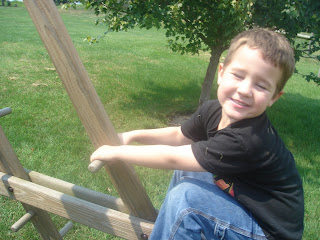
Thomas on the see-saw at Rayba Acres


Nate and Seth chill out under a tree at Rayba Acres

A sign hung in our room at Rayba Acres. Cute or weird for a B&B?

(Plaque reads: "For Maid Service, Ring Bell...if no answer, Do It Yourself")


For those who think Salt Lake City is too explicitly religious, check out these things from restaurants in Lancaster County, PA:

A place mat at our table

("The prayers of your faith are shown to assist you in saying 'Thank you'")

A wall-hanging across the dining room of the Shepherd's Psalm.


An advertisement outside the door that reads "Believe on the Lord Jesus Christ and Thou Shalt Be Saved"


The kids enjoy Strasburg's train-centric attractions


Thomas loves the LEGO display at the National Toy Train Museum in Strasburg


The "Choo Choo Barn" in Strasburg pays tribute to Old Glory as part of its 1700 sq. ft. tabletop train display. Sethie danced here to the playing of patriotic music.


A motorized circus display at the Choo Choo Barn

Sethie spends almost all his time at Cherry Crest Adventure Farm in the "wheat barn".

What can I say, he's a cautious kid.

Next up: The Gettysburg Battlefield Memorial

Thursday, August 21, 2008

Revenge of the Snacky Pack

So Nate has been off work for the last week and we've been trying to actually get off our duffs and go places. On Sunday, we headed to the beach for the first time all summer and Monday through Wednesday we spent in Pennsylvania Dutch country: Lancaster county, PA (don't do like Mara and say "LAN-CAS-TER" or you'll give yourself away as a rube. It's "LANK-ca-shire"). On our last day in PA, we jumped over to Gettysburg to tour the battlefield and bone up on our civil war history.

It's always interesting to get the adult reversal of one's long time kid-only perspective on certain family outings. Car trips, for instance. Is there anything more frustrating to a kid than long hours strapped in a car seat next to a sibling competing for toys and entertainment while the adults make dismissive remarks such as, "Well, just look out the window and enjoy the scenery", or "Why don't you see how many different license plates you can count?" I think wardens have also suggested the same thing to prisoners whose single-windowed cells overlook a highway. Even prisoners get some exercise time and TV access.

And yet, as an adult, the concerns of kids seem petty. You think, "Ah, cruising through the farms of Pennsylvania: everyone should love this!" and when they don't you say dismissively, "Well, just look out the window and enjoy the scenery," or "Why don't you see how many different license plates you can count?" If Nate suggested I count different state license plates under any kind of circumstance, you'd bet I'd clobber him.

The other problem: food access. The adults have it. Before we left, I bought up some little packets of crackers and cookies for the kids to eat during the long hours in the car. I made the mistake of calling them, "snacky packs" to Thomas. Now Thomas has two particular interests at this stage of his young life: food and entertainment. He is always in pursuit of one or the other or, most often, both. I am his mother. I am the food and entertainment gatekeeper. Most of our conversations during the day go like this:

Thomas: "Mommy, can I (eat X/play Y)?"
Me: "Not right now it's (time for school/time for bed/right after you just ate/the middle of the night/etc.)"

At least during the day Thomas can run off between food requests and do something else. In the car, Thomas was strapped in directly behind me. We could not escape from each other. Round trip through PA Dutch country and Gettysburg was about eight hours in the car total. At least seven of those hours were taken up by Thomas asking, "Mommy, can I have a snacky pack?" Sometimes he would ask if he could have one while he was still eating the last one. So he would say, "Muffle mumble scarf snacky pack?"

Even worse, the more often he asked for them and the less often he got them, the more the term "snacky pack" began to take on a certain nasally whine, the kind of which makes dogs howl and parents go blind.

Thomas on the use and pronunciation of the term "snacky pack"


Nate as designated Dad driver--you know the kind: doesn't turn around and doesn't stop for anything less than imminent bladder expulsions--began to truly loathe the snacky pack. He hated when Thomas whined for one and he hated me even more for having introduced the term. As the trip progressed, his right eye started to twitch. His muscles began to tighten. About an hour outside Philadelphia right after we had actually stopped to feed the children real food (well, service station food which counts as real only so much as it is being compared to snacky pack nutrition), Thomas made the mistake of asking for a "snacky pack" one too many times.

Nate roared, "If I hear the term snacky pack one more $#&@*! time, I will throw every single one of them out this window!"

I started to cry--cry with laughter, that is. I was rolling around the seat absolutely hysterical. Nate started half-smiling/half-grimacing and pinched my arm repeatedly in revenge. Thomas was looking between us, semi-hopeful that 1) perhaps he wasn't in trouble and 2) he might actually get a snacky pack.

In the end, the snacky packs did not meet hot pavement and Thomas learned how to ask, "May I have a snack, please?" in a far less whiny manner. I ended up with only a little arm bruise.

And we have, hopefully, learned our lesson: no more cute food monikers during car trips.

Next up: Live Like the Amish....Until You Get Tired of it

Thursday, August 14, 2008

Holy Vocabulary, Batman!

Geez. I've been posting lately about as often as Nate sleeps. Anyway, here is Sethie nearing the two-year mark. He's actually got a vocabulary of over 50 words at this point (I know, I know, that in itself is pretty average for his age, but considering his preemie status, I'm constantly grateful that he is happily average), but I've asked him to repeat just a few of those.

When Thomas was a baby, Nate was always insisting I cut his hair--he didn't like the fluffy baby look on him--but he's changed his mind with Sethie. Maybe we've finally realize just how quickly they are both growing up and so we are happy to keep Sethie looking like a baby for just a little bit longer...

Wednesday, July 09, 2008

A Hot Day for a Five-Year-Old Capitalist

When I was a kid (this will date me for sure), I played a text game on our Apple IIc called Lemonade Stand. The goal was, of course, to run a lemonade stand and earn as much money as possible while still factoring in such crazy variables as whether it was sunny, cloudy, or raining, how much you spent on supplies and advertising, and such. I was likely only about ten or so at the time I played it, but it didn't take me too long to suss out that Lemonade Stand was the result of a rather lazy programming effort. There were certain key numbers that would guarantee you a maximum pay out. It wasn't random at all, but tied to a specific algorithm that had its golden inputs. The number 53 sticks out in my mind. I'm pretty sure that's how many cents you charged on a sunny day. Any more or less would result in sub-optimal profits.

Later, I got to put this little nugget to good use when my homeroom at school had a Lemonade Stand playoff (this was when computers were still so novel that it was considered good for you to play games on them during school). I took first place by a rather astounding margin as I recall.

By contrast, when I was a girl scout, the inevitable time arrived when I had to sell girl scout cookies. The point was to sell enough to attend girl scout camp--about $75 worth, I think. Now, girl scout cookies are ridiculously easy to sell. People love them. Post a girl scout cookie order form in any office lunchroom and it'll be full by the end of the day.

I sold a couple of boxes to my parents, and some to the neighbors across the street. I think, in the end, I made about $15 total. My dad rather generously made up the price difference so I could actually attend camp. If you're reading this, thanks Dad.

The moral of these stories, I suppose, is that I eventually went into computer science, not business. Algorithms make sense to me. Attempting to get actual people to purchase an actual product doesn't.

Which is why I got a thrill of trepidation today when Thomas declared out of the blue that he wanted to have a real-life lemonade stand.

I'm not proud of it, but I actually tried to talk him out of it. We didn't have anything to make lemonade, and the day was very cloudy (subpar profit margin!), even though it was warm and humid. Also, I felt self-conscious, the same way I felt approaching people for their money when I was a girl scouter. Friends and family: no worries--I will never become one of those people who market random products to their harassed loved ones. You are safe.

But Thomas, good for him, was adamant, so we headed for the store and bought up nearly all their teeny bottles of lemon juice (you know the obnoxiously small lemon-shaped ones). At home, Thomas helped me mix the sugar, lemon juice, and water into something resembling a tasty drink and together we decorated a blue poster board that stated "Lemon-Ade 25 cents". Then we dragged out an old table from our shed, rinsed two hundred spiders and their egg sacs off it, and put up the whole operation in our frontyard.


To get my Bub started, I gave him two quarters, one for me and one for him, so we could each drink a glass of our own product (Future entrepreneurs, take note. This is good business practice). Also, it helps to have a little money in the money jar from the start--then people think that someone else has already vetted your merchandise.

For about fifteen minutes, many cars passed, but we had no action. Thomas started out thrilled at his adventure in business administration, but soon became despondent. "No one wants my lemonade," he said, lower lip making a bit of a quiver. Just as despair was setting in and Thomas was asking that we start going door to door and asking people to buy it, we landed our first customer. A woman in her late fifties was crossing from the Acme parking lot just a little down the street to our table! "My husband gave me this quarter and asked me to get some delicious lemonade from that handsome boy here," she said. I helped Thomas pour and he eagerly presented his money jar for payment. Hearty thank-yous were exchanged around and she went back across the street.

The elation lasted another twenty minutes or so before once again Thomas decided the business was a failure. No one else was stopping. I urged him to give it a little more time and that selling stuff often meant sitting on your heels for awhile, but eventually he crawled into my lap and said he wanted to go inside. I said okay, and he disappeared into the house while I started to clean up the table. Just then, a van pulled into our driveway. A woman popped her head out the window. "Is your little boy still selling his lemonade?" she asked. I called Thomas back outside who looked like he might give her a big sloppy kiss. She gave him a dollar and bought two cups, telling him he could keep the change.

After that, the customers just started to flow. "Maybe you're getting excellent word of mouth," I told Thomas, who studied me in confusion, but didn't ask me to elaborate. Several bike-riders stopped by. A man in a business suit stood in our front yard to drink his lemonade, declare it "excellent", and say he just couldn't resist a little kid trying to make a buck. We served our final two drinks to a beautiful couple in a brand-new BMW that glided, shining, into our little gravel driveway like Apollo's chariot arriving. The driver also gave Thomas a dollar and told him to keep the change. Thomas has no idea what that means. I would have had a much harder time trying to get him to actually return any change.

In the end, he pulled in almost four dollars with his little lemonade stand operation and was an electric bundle of entrepreneurial spirit as we headed into the house. Later, after Thomas had decided--wisely, perhaps--to infuse his cash back into the economy rather than risk losing it in the market, we headed to Target, where he started out wanting several bouncing balls, but eventually settled on a Milky Way bar and some Sour Patch Kids. I wondered if he would notice how long it had taken him to earn the cash versus just how quickly he could spend it, but he didn't say anything. Finally, I asked, "I hope that you're happy with what you bought with your hard-earned profits?"

He said, mouth full of caramel, "Oh Mommy, I really am."

Wednesday, June 18, 2008

Kid Tested, At Least

I swear, I was upstairs for all of five minutes.

Of course, that's all the time they need.


Tuesday, June 17, 2008

Father's Day Thomasism

This last Sunday, Thomas (and his church class) sang "Home is where the heart is" for Father's Day. Afterward, he came down from the stand and climbed onto my lap. I noticed he was crying (just a little), and I asked him if he was okay. He said "Daddy, sometimes you are so happy you just cry. I love you Daddy."

Needless to say (though I am saying it), it was a wonderful present.

Monday, June 02, 2008

7 Years into Eternity

Seven years ago this morning, I followed through on the best decision of my life - I married Maralee LaBarge. There is no way to express how truly lucky I feel that she decided to be my wife and mother to my children. I have a hard time trying to remember what life was like before I met her, but it was obviously incomplete. I feel very lucky to have found my soul mate.

I LOVE YOU MY DARLING!

Saturday, May 24, 2008

Thomism

A song today on the way to soccer practice:

"Never leave your head,
Never leave your shoulders,
Never leave your mommy alone,
That's why I drink this special drink..."

Monday, May 19, 2008

Nerd Grrl Street Cred

Okay, so this isn't a real accomplishment, which is why the blog is probably the only appropriate way to crow about it, but I recently beat all 120 levels in Super Mario Galaxy. Oh yeah baby! (Thomas is now trotting out that particular phrase whenever he does something well. Should I feel guilty?) Despite the fact that I play games regularly, I've never been hardcore--in fact if a boss fight seems boring and tends to take too many retries, I'll usually just ditch the title for the next game in my lineup. But something about Mario Galaxy has kept me playing.

Once, you could tell the console pros by their zen stillness during play. Beginners have a tendency to whip the controller around in a desperate attempt to get their little guy pixels to do what they want, despite the fact that the controller can't tell whether it's in your lap or flying through the air. Well, until now. I used to be one of those zen players, sitting in silent, button-mashing ohm-position. But the Wii remote has changed all that. Now I careen around on the couch as wildly as before. I even move the remote in ways totally unhelpful to gameplay. In Galaxy, Mario can change direction midair by shaking the remote and pressing the control stick in the direction you want to go. However, I also yank the remote in that direction, even though I know it's useless. I can't help it. The Wii has unmade me back into that silly kid again who whirled the controller around and yelled at Megaman not to fall off the edge. And that's probably a good reason why I can't stop playing it.

Anyway, beat all 120 levels and you get to play Luigi. Beat all 120 levels with him and supposedly the 121st level opens. Beat that...and I don't know. We'll find out when I get there.

Until then, watch this video of a guy beating one of the hardest Galaxy levels: What looks like an old school Luigi sprite from the original NES game turns out to be a map full of rotating boards, disappearing squares, and green muck that serves up an instant kill. The goal is to collect 100 purple coins (out of the 150 available) and make it back to your starting position all before time runs out. I felt pretty cool finally slogging through it after about 50+ retries.

Obviously I'm still just a grasshopper. Mr. Miyagi, is that you?

Monday, May 12, 2008

Waiting for Godot

Seth has been a real character study for me after being swept up in the whirlwind that is Thomas for four years prior to his arrival. When Thomas was 18 mos. old, his favorite game was to run across the living room and have us pelt him with pillows. If he got knocked down, he only laughed harder. In fact, I once sent him careening into the wall and as I was running for him, imagining how I was going to explain his head wound in the ER, he emerged from the pillow pile, a huge red spot on his noggin, laughing hysterically.

He's also been a water baby all his life. Readers of this blog know that when we hit the beach in the summers, Thomas flings himself into the ocean, chaperoned or not, and has survived a few near drowning misses. He seems to have no fear, which is good in the sense that he has always been willing to try new things and adventures, and bad in the sense that I have been living with a near heart attack for most of his life as I wait for age and reason to finally overtake his lack of pain sensitivity and tendency to rush headlong into danger. I suspect I've got a number of years to go on that count.

Of course, it's a stereotype that the second child is often the categorical opposite of their first, but Seth and Thomas really do fit that bill. Where Thomas is easily distracted, Seth is methodical and while Thomas is easily pleased, Seth is a little more...discerning, let's call it that. Nothing seems to illustrate their differences as well as the following videos of a little sprinkler-running action in our backyard. Note that Thomas is not running through the sprinkler with such happy abandon just because he's older and is more comfortable with the experience. He was happily dousing himself in jets of water from the time he was a year old.

Sethie is my sensitive baby, the one who checks all the variables before turning the ignition, but I'm proud of him, too, that despite his obvious fear, he keeps going back to face it.


Monday, April 14, 2008

Happy Birthday Mr. T

I know I'm merely echoing a parental cliche today when I say I really can't believe that Thomas, my little Bubby, is turning five. I looked at him a few days again and said to Nate, "When the heck did he get so huge?" As people, we're aware of the passage of time and yet our children seem to be always be the age that they are, if that makes any sense, and we can hardly remember when they were smaller, nor imagine them bigger.

Thomacito, my burrito, my favorite monkeyhead, my bubby wubby and my schnoot...I'm crying as I write this. I love you so much. You are such a big boy now and I see you headed out to conquer the world. You are fearless and generous, gregarious and hilarious. You are the only you and I'm so grateful to be your mommy.

Happy Birthday.

Tuesday, April 01, 2008

The Poulsens Went to Hawaii and All I Got Were These Lousy Blog Posts

I kept this diary during our recent weeklong trip to Hawaii. I will also be posting some pics along with the entries just as soon as I can get them all organized!

-Mara

Chasing the Afternoon
3/16


We boarded the plane about 1:30 pm. Despite the cool drizzle of rain we’d had on the way to the airport, it was sunny now, brilliantly so as we squashed into our ridiculously small coach seats. When we take off the sun is a beacon of immense potency ahead of us, reflecting off voluminous and voluptuous rolling cloud hills.

It will stay that way for 11 hours.

I thought about the stories where a man chases the rainbow for its pot of gold and how he must pursue it without looking directly at it because if he looks, the rainbow will appear to be as far away from him as when he started. So it was with our afternoon. We could never catch it. Across five thousand miles, six time zones, land and ocean, we chased it. The clouds were the land we tracked it over, sometimes generally flat but gently rippled, like fields of the Midwest, other times bulky and spiked with sudden drop-offs into open valleys like the Wasatch Mountain range where I grew up. We flew fast and free over our terrain, but the sun kept ahead of us and like Icarus we groped and groped toward it and eventually fell—touching down in Hawaii in defeat.

And we were really were defeated then. As we descended the sun was growing pink and distant, the cloud volcanoes—grand cones of them erupting out of otherwise flat cloud fields—above Honolulu serving to hide it. We touched down, deplaned and headed for the baggage claim. Behind us the afternoon ended and, in barely a few minutes, it was dark.


Capitalism, the Scourge and Savior of Hawaii, Part One
3/17


This morning, we left the hotel and headed hand in hand down toward the beach which the hotel’s website had promised was a mere twenty-five yards away. I had seen the ocean from the balcony of our hotel room, its placid blue speckled with tiny whitecaps, and thought that maybe we could grab a spot on the beach, break out the books, and spend a relaxing morning acknowledging our feebleness to its immenseness. Why is it that recognizing how much more great and powerful nature is compared to us results in a feeling of pure contentment? Something to explore later, maybe, when we hit Volcano National Park.

Only the beach proved just about as elusive as the sun had yesterday and the resort area with all its tiny shops in bright colors that had looked so cute from our balcony turned out to be teaming with parasites. Five minutes into our walk, we were accosted by an otherwise harmless looking woman in a sundress and enormous eighties hair who wanted to know all about us, where we were from, how long we were here, what kind of things did we want to see and did we know she could get us discounts to things, why didn’t we step inside, etc. Our spider scam sense that New York hammered into us should have immediately kicked in, but hey, this was Hawaii, we were happy to be wandering down to the beach, she looked so nice, blah blah blah. We told her we had come here by taxi, but were looking to rent a car for the remainder of the week and did she know if there was a rental place nearby or did we have to go back to the airport? “You have to go back to the airport,” she said, “but I live right by there. I’d be happy to take you. When do you want to go?”

Scam alert! Scam alert! We told her we were on our way to get some breakfast, but we’d be back up this way later. She said, “There are a lot of people like me down the beach who’ll try to talk to you. Just tell them that Diane is helping you, okay?” I was already hard tugging Nate out of there—I’m a total misanthrope, I admit it. I hadn’t come to Hawaii to chat up strangers. I think she guessed I was the less friendly of the two of us because she weakly tried to win me over by shouting after us, “You have such pretty hair!”

In only one sense did she end up telling us the whole truth—she was absolutely right than this little stretch of otherwise adorable open-air shops and restaurants was overrun by “people like her”. We spotted a sign for a deal on luau tickets and the instant I pointed it out to Nate another Diane-type popped up. “Now the luau tickets are normally 72 per person, but I can get that down to 28 for both of you together,” she said. “And there is snorkeling over at the Kona Resort bay—you can see Green Sea Turtles there—and we can get you set up with all the equipment. And are you going to the volcano? We’ve got a great deal on the airplane tours, that’s the only good way to see it, you know…”

So what did Diane and her many prototypes want with us for these amazing deals? Just a few minutes of our time, really, a small price to pay, just come to our presentation about a timeshare option, no high pressure sales tactics we promise, and then you can have the rest of the week to do these fun things which we will give you for practically nothing! You have such pretty hair!
I think it is possible to get a good deal out of a timeshare buy. Nate’s parents did it for years, but it requires you to deal with a constant barrage of pressure to buy more more more. Like I said, I’m a misanthrope. When I go on vacation, I go to be alone (or in this case, to be with just Nate who, with work and school, is normally gone all but eight days out of the month).

But then again, all of these other things they were hawking really were more expensive on their own. Wouldn’t it be reasonable to go to a little sales tour, reject the pitch, and then get all these great discounts?

I’m a big fan of Capitalism—I think other more communal economic ideals sound great on paper, but in practice become coercive and stagnant. Free markets are the best and only way people can build their own wealth and that freedom has turned America into the wealthiest nation on earth, but it made me more than a little grumpy to spend the first few hours of our vacation trying to navigate the maze of “marketing representatives” who, like the jumping spiders Thomas loves, had staked themselves in the obvious path of their prey and then waited to spring.

But what about the luau, an event I had wanted to do before the sticker shock of a timeshare-presentation-free price hit me? Do we try to trick the timeshare troopers on their own turf to wrangle a good deal or we do we shell out the big bucks? Which is more valuable, I asked Nate, our time or our money? Which option makes us feel the least like suckers?


Capitalism, the Scourge and Savior of Hawaii, Part Two


I don’t know what it’s like to be native Hawaiian. I suspect for those living here now, it’s like being anyone else with an interesting historical background that has little effect on your current way of life, but then again, maybe not. Unlike most other “interesting historical backgrounds”, Old Hawaii is still here, encased in a time capsule, and it only costs 72 bucks per slack-jawed tourist to catch a glimpse of it.

Supposedly, anyway. As much as I want to see fire and hula dancing and a full roasted pig, the idea of a luau turned poisonous to me the longer I listened to these timeshare parasites hawk their discounts to it. I know there are real luaus in Hawaii, but they are private affairs, and a Hawaiian-shirt-wearing tourist can’t purchase his/her way into them—wedding luaus, birthday party luaus (bar mitzvah luaus?!?!?).

Capitalism has saved Old Hawaii in a way. I asked Nate last night if the Hawaiian language is a bit like the various Gaelic dialects in the British Isles, living on for nostalgia’s sake and because there are people like us who have fetishized it and crave a piece of it and are willing to pay for it.
How do you preserve a cultural heritage without selling it? And how do you separate nostalgia from history? Would Old Hawaii still feel as vibrant here if there weren’t tourists to feed it? Is that a good or bad thing? And how much of it is real?

At a wedding reception a few years back, I ran into a fellow from Ireland and got a chance to gush about how I just loved Ireland and how wonderful it was even though I had never had a chance to be there and he replied sullenly, “You don’t love Ireland. You love what you think Ireland is. All you Americans think Ireland is this lovely green magical place, but it’s not. The cities are dirty and stinky and the country is poor.” That was pretty much the end of the conversation.

I don’t think that Hawaii much fits the description of the angry Irishman, but how much of that is from wrapping some romanticized version of its past into a package palatable and priced well for tourist consumption?

Nate and I never did do the luau. The timeshare discount vs. full-price admission turned out to be a zerosum game for us. Either the timeshare people win or the luau marketers do. Instead, we drove about twenty miles north to a pristine and wildly expensive shopping center at Mauna Lani because at 7 pm every night, there is a free hula performance by Traditions Hawaii. In the midst of this tightly stylized pedmall disguised as a Hawaiian village, we watched a dance recreation of King Kamehameha’s secret birth and rise to power among the Hawaiian tribes. It was simple, the dancing was fantastic, and it was only briefly interrupted by a bizarre English pop song performance by the lead that some moron probably thought was necessary to keep the unwashed American masses interested. Was it authentic? Who can say? It was authentic to what Hawaii is now, tourist and tradition intertwined, the two symbiotes feeding and sustaining each other. Afterwards, the viewing audience toured the shops in the compound, which is probably the main reason the performance was free. Nate and I bought some crackers, cheese, and dried mango from the over-priced grocery store and headed home.


Mara vs. the Volcano
3/18


It’s raining tremendously here, but without wind, so I can sit on the hotel balcony, listen to it pounding down, smell the salty residue of an ocean rain. We will be in Hilo today where it has rained every day of the week. The storms blow in from the east and cannot climb Mauna Loa, the Big Island’s grim volcanic summit glowering more than 13000 feet over the rest of the us, so most of the time it drops all its rain on the eastern side, which incidentally is where Kilauea, Hawaii’s last constantly exploding monster has been spewing since 1983. Fire and water, natural enemies, imprisoned on the same piece of the island together.

The volcano is our ultimate destination today, but we started on the Kona side of Big Island, the touristy beach capital where we chose our hotel, partially to escape Hilo’s rain. But that means that in order to see the volcano and to come back home again, we will have to round the entire island in a day—almost a 300 mile round trip—on the Big Island’s single circuit highway which winds sinuously around the perimeter, climbing from sea level beachfronts to 3000 foot elevations and then back down again, all the while twisting like a canyon road and sometimes dropping down to 35 mile an hour speed limits. A scenic way, but not one for getting places in a hurry.

We stop for breakfast at a tiny roadside café that looks like a rickety shack on the outside, but is surprisingly lovely on the inside. It is perched above a cliffside that plunges at least a hundred feet below us over the side, but what a fragrant ride down it would be. The rise is overrun with flowers, long cones of them in red and white, and there is even an avocado tree hanging heady and fully ripe only a few yards away. I love that in Hawaii, all the restaurants are open air. There is no reason to have walls—it just never gets cold enough. It felt a little deviant to me the first day here, that everything is just open and anything can wander in. I’m used to barriers and it challenges my natural inclination toward safety.

Speaking of anything wandering in, a tiny green gecko is climbing the wooden beam near our table. My heart thumps. How much I miss Thomas! He would have loved to see this adorable little lizard sunning himself barely a foot or two away. I have to sneak close and take his picture. I take a video, too, so that when we get home Thomas can see how it looks and moves. I wish I could take something like this home for him. He’s a touchy kid—a flat screen of moving pictures is totally inadequate. He likes texture and weight. Asking him not to touch is like asking him not to breathe.

The food is also surprisingly elegant—silky papaya stuffed with apples and pineapple in a cream sauce and toasted coconut and Nate’s eggs benedict which are served on little crisp biscuits and artistically dripped with hollandaise. Everything we’ve paid for so far in Hawaii has been ridiculously priced and the prices here are as high as elsewhere, but for once, the food actually approaches “worth it”. The single waitress is an older white woman in ragged jeans and a halter top, with long blond hair just loose. She looks like a hippy who just wandered in once and never left. She is pleasant and has a calm glow about her, like the rest of this place.

Back on the road, we don’t have a real schedule, except to reach the volcano by early afternoon, so we decide to stop wherever sounds interesting. We pull off next at Pu’uhonua o Honaunau, the last “Place of Refuge” in Hawaii that the National Park Service has managed to preserve. Apparently in the old Hawaiian religion, kapu was code of conduct—mostly acts that were taboo—so severe that managing to even accidentally break one of its laws meant death. And considering the laws—women can’t eat with men, you can’t walk too close to a chief or even cast your shadow on him, etc.—the chance of breaking one accidentally seemed pretty high. Fearing the gods would punish them if they harbored a law-breaker, the people would chase you until they either caught and killed you, or you reached a place of refuge where the bones of old chiefs are buried and blood cannot be spilt. The priest would absolve of your crime and you could go home again—at least until the next time your shadow fell in an inconvenient direction, sinner!

“Let’s build a wall to protect ourselves from our own ludicrous system of justice!” I snarked to Nate while we toured the grounds. They say that Louis XVI of France had a extreme code of politeness at his palace gatherings—you had to scratch at the door to be let in, you couldn’t knock, etc.—in order to keep his nobles so occupied with etiquette that they couldn’t plot against him. Unfortunately for Louis, it was the peasants who ended up plotting against him, and peasants don’t get invited to those kind of parties.

Unsurprisingly, most of the kapu rules focused on women and what we could and couldn’t do. What is it about us, men? We don’t spend our time coming up with rules that are for you and you only. I mean, yes, you have to pick up your socks and use a coaster, but so does everyone else.

Weirdly, though, one of the laws was that a woman couldn’t cook a meal for a man. Who came up with this rule? Maybe you could also forbid us to do your laundry? I have a few more things on my list that I could be forbidden from. My guess is that for this reason alone the whole kapu business eventually went out of favor. How many years of cooking their own dinners before the Hawaiian men chased the original rule-maker himself all the way to Pu’uhonua o Honaunau? “And stay there,” they sniffed, walking back home to a warm meal.

There was also this guy at the National Park Service site. Nate tried to ask him a question and he barely looked up response. We’re not quite sure if he was actually supposed to be there as a part of the exhibit. Maybe the lightweight NPS rangers were too afraid to ask him to leave. I would be.

Sea turtles are swimming in the shallows here. We get as close as we dare and rapidly snap pictures.

Back on the road. We stop at a cliffside where the wind is rushing violently across the beach and up the hill. It is covered in lush vegetation and the waves below are smashing majestically against the land. Someone is flying foam airplanes on the hillside—we can see the planes but not the people. They look like a flock of some strange local bird.

“Black sand beaches!” I yell at Nate about two seconds before we miss the turnoff to Punalu’u. We have already passed the southernmost tip of Big Island and are working our way up the opposite side now toward Volcano National Park. Nate yells, “Where?!” even as he is slamming the breaks and careening the car around. We bounce onto the exit, our little rental car kicking up in the back like a donkey (Hi Alamo Rental Car Service!), but manage to not to go skidding off the road. We wind down to the beachfront which, unlike almost everything else here in Hawaii, has no entrance fee. People are just parking and getting out. The only real sign says it’s illegal to remove any of the sand from the beach. I don’t really know why until I get a chance to stand on it.

Obsidian. The most beautiful of volcanic rock. What looks like a long swath of mud leading down the water is, in fact, miniscule shards of obsidian, so miniscule that they look like glistening grains of black salt in your hand. The sand is soft under the feet, like any sand, only it’s dark and shiny. I sift it through my fingers in wonder. Nate tries to scratch our initials where the surf has soaked it but he can’t finish fast enough for me to take a picture before the foamy sea obliterates it. He manages to build a little mini-Volcano, though, and we cap it with a fallen yellow flower. Then in comes the water again and sluices the whole thing away.

Finally, Volcano National Park. We’ve come up the Hilo (eastern) side of the island now and into its rain. A fine warm mist is coating the car (and us) as we make our way to the visitor’s center.

All I want—all I have wanted for this whole trip—is to see lava flowing. We rejected the overpriced air tours because we want to see it for ourselves, if we can, hiking as close to the molten earth as we can get and with no panes of glass between it and us (okay and prop plane rides like that make me soooooo motion sick, even when I’m well-drugged. Last thing I want to be doing over the Volcano is erupting myself. Everyone together now, “Ewwwww…”).

Inside we stumble into the park ranger telling a group of hikers that up until a month ago, the only way to see the lava was the take one of those plane rides, but the lava has changed direction and is now actually running into the sea just east of here. The only way to get there is to drive up highway 11 for twenty miles, turn onto highway 130 for another twenty miles and go on past the roadblock at the end of it, follow the remaining gravel road to a small parking area, then break out the flashlights and cross the old lava flows to the sea where, in the near distance, molten rock and water are violently clashing, throwing steam and stone sometimes thirty feet in the air.


It’s easiest to see the lava after dark, so we have time to drive up to Hilo for the last event on our semi-itinerary: eat the very last cheap food left in Hawaii, the Loco Moco. Café 100 is one of Hilo’s oldest fast food joints, having been around since the 50’s. It’s named for Hawaiian’s 100th Battalion from WWII, a battalion full of Japanese soldiers. The Loco Moco is its own invention: a hamburger patty topped with an local island egg over white rice and smothered in brown gravy. Does this sound like Nate food or what? It costs a measly $1.99. We have seen Loco Moco imitations around here in Kona, but their price hovers somewhere between $5 and $9. Not only do we want to try the real thing, but we’re also tired of feeling like suckers every time we break open our wallets.

We know we’ve reached the island’s biggest town because of the Wal-Mart. And three MacDonald’s, all within a two mile radius of each other. Aside from the main strip, though, Hilo is almost all squat little island houses: single-story with steeply tilted, corrugated roofs. We drive through them to Café 100 which looks like it’s still in the original 50’s building (it isn’t: tsunamis destroyed two earlier Café 100’s before this one was built). The café is rough-hewn and looks like any roadside pit stop serving fast food. They have about ten different Locos on the menu, including a salmon tempura loco that I order. Nate gets the real thing. We eat them at one of the many picnic-style benches around the perimeter. My egg is overcooked, but Nate’s is just right: he draws a line through the center of it and thick, wet yolk oozes out to cover everything. I’ve seldom seen him happier.

It’s a little after 4:30 pm by the time we’re grinding the rental car over the gravel road (Hi again Alamo Rental Car Service!) to the lava site. The road is so tight that any car trying to come the other way has to negotiate a careful waltz with us—one tire this way, one tire that, spin your partner around and then go! We find a place in the parking lot where rangers are handing out flyers with safety tips on them. I’m still blown away that they even try to let people do this, what with the tort-happy union we live in. Out on the newest lava flows, the benches are completely unstable. Recently 43 acres disappeared into the ocean overnight. One wrong step and you’ll go plunging into the abyss with it. Not to mention the sulfur dioxide in the air which is toxic even to the average healthy person, let alone anyone who already has breathing problems. The rangers have set up markers to show the best way along the lava flow, but there’s nothing to force you to stay with them. Good luck intrepid tourist! Hope you come back alive!

In the distance, smoke and steam are spurting up in great clouds. The air is practically sizzling—I can see the heat waves warping the black hills behind us. We pick our way delicately over the ripples of cooled magma. This whole area feels delicate, like a frozen pond, that any moment this thin surface could crack and we’d take a sudden and very hot bath.

We reach the end of the bench. Although there is lava flow still beyond us, about an eighth of a mile’s worth that reaches the sea, that part is new lava flow and not likely able to carry the weight of a few hundred tourists tromping back and forth across it day in and day out. We crawl up on a near rock outcropping to better see the clouds of steam that are shooting up from the water about five hundred yards away from us. No lava is immediately visible, but the afternoon is still bright and if there are flows they are too thin to make a dent in the sunlight. Until—there! In the distance the black shore cracks and the earth’s red blood spurts out. Everyone oohs and ahhs and a cacophony of camera clicks follow. We try to take a picture of it, but our little camera barely has a zoom factor of 3. We get a great picture of the steam clouds and what looks like an artifact of red on an otherwise dark field.

For a long time, that is all there is.

Nate and I find a roll of pumice to still on and wait for sunset. A few feet away from us a little boy is tossing lumps of it, watching parts of them disintegrate into dust when they hit. His father comes by to tell him to stop. He stops for a moment until the father wanders away again and then he picks up another and throws it. He’s turned toward us now, completely unconscious of the people around him. The next rock he lobs lands at my feet. His father is back, grabbing his arm and telling him in a harsh whisper that if he doesn’t cut it out, they are going right out of here and there’ll be no lava for him, now quit it! His mother glances sharply over here, too. “Stop that or the park ranger will arrest you and throw you in jail,” she says offhandedly to her son. Nate and I have to snicker behind our hands. Whenever Thomas is doing something even semi-dangerous, I find myself saying whatever possible to get him to stop. “That’s a good way to lose your head!” I’ll say, to which Nate will add, “Yeah and then you’ll have to get a monkey head.” I don’t think I’ve ever threatened him with arrest and possible jail time, though.

The sun is going down so we crawl back up onto the edge of bench as lots of people are arriving by now and we want a good viewing spot. Here and there little bits of red are starting to appear across the otherwise empty field. Unlike our flight to Honolulu, the sun seems to be taking an abysmally slow time to set. But the steam clouds are turning crimson. Now and then the wind will shift a bit and blow them away from the land and there…the shoreline is awash in lava. Wounded, it drips its blood into the sea and the sea explodes. An awe and terror quite unlike anything I’ve ever felt is making my heart beat fast. My chest feels light and hollow, my lungs not quite able to fill up.

All around us, Hawaiians have tossed offerings to Pele, their volcano god that lives in Kilauea: leis and leaf-wrapped bundles. A collective shout goes up from the bench as one daring grandmother is being escorted by a Civil Defense policeman out on the new flow—the one the rangers ordered us never to step foot on—toward the lava. I hear someone saying the Lord’s Prayer behind me. They stop roughly a hundred yards from the lava. Grandmother raises her arms in the air, appears to be chanting. The bench here is quiet, people whispering back and forth. She tosses the lei she has brought and they start back toward us. When they reach the bench, there is a collective sigh of relief.

At last the sun is gone and although everyone around us is raucous with excitement, talking and taking pictures, Nate and I are quiet. He has taken the advice of a photographer near us and is resting the camera on a flattened part of our backpack, pressing the timer then letting it go. But no camera can really capture what it looks like from this high slope above the lava fields. In the dark, the lava is livid. You can actually see the different shades of it as it oozes through the stone of its own make, a shifting pattern of red and yellow and orange, liquid fire on the hunt. For over thirty years it has groped its way toward the sea from Kilauea’s angry mouth. The water hisses and spits at it, then erupts into great mushroom clouds of steam. You feel like if the ocean weren’t so very vast, the lava would have gobbled it up already. Thomas, fascinated by fire like any little kid, wanted to know if there were any fires that water can’t put out. I said yes, of course, and talked to him about grease fires and big forest fires, but this is the real fire. I wish desperately that he could see it. The water seems to be no match here—and yet, like the Union side of the Civil War, survives to triumph on sheer numbers. Down, down the lava drips and the greatness of the ocean devours it at last. The glow dies out and black stone is all that is left. Fire and water. Both win, both lose.

We have a great spot here on the bench—our view is obscured by nothing—and so eventually we decide we ought to give it up to someone else. My leg has fallen asleep. Nate helps me down and we have to break out the flashlights from our pack to pick our way back across the lava flow in the dark. Behind us, the sky is alight, enormous crimson clouds rolling away. The sound of the sea shushing back and forth against the shore is constantly broken up by the erupting hiss of steam. We are lucky to be able to turn our backs on that ancient battle and go home. I doubt we’ll ever see its like again.


Catching up
3/19


After our Big Island adventure yesterday, today is a lazy day. We sleep in (until 6:30 am! This is an improvement over yesterday where we woke up at 5 am. We just can’t shake this Jersey time. Helps us get on the road, though) and grab breakfast a beachfront buffet, but I feel grumpy all over again. The buffet is $8 a person and consists of some hard breakfast burritos, sloppy eggs, freezer-style hashbrowns, and dried-out biscuits. Drinks are extra and limited to a single refill. I’m beginning to feel like my mother-in-law who went grocery shopping with me last Thursday. She had just come from Mexico and made sounds of distress every time she confronted a price tag. My instinct is that ordinarily things in Hawaii cannot possibly cost this much, but that, like anywhere, the tourists are too easy a target. They are also serving a Loco Moco here. It costs $10.

We give in the price-gouging spirit, though, and go shopping along the Kailua-Kona shore. I get a little artificial flower hairclip for a not-too-terrible amount, despite the fact the clip-part is just hot-glued onto the silk flower. Nate wanders into a natural wood open air market and calls me over. We tour the carvings and bump into the owner, a fit tan guy in his forties who is wearing only a pair of board shorts and shell necklace. An old surfer dude who set up shop on his favorite shore. Everything is hand-carved here and there are painted pieces of extraordinary workmanship and even more extraordinary price tags. We find an unpainted piece—an intertwined male and female figure—that looks like it would fit in among other things at home. There are two styles: Nate wants to get the more “voluptuous” one, but I veto it. She looks a little cold to me.

We take a long afternoon nap—the humidity and the heat make sleep deep and delicious. When we wake up, it’s late in the afternoon and we have only one destination left: Sushi En Fuego a Japanese-Spanish fusion restaurant right on the beach. We’re hoping to see the sunset—every night we’ve been here so far, we’ve been off doing something and didn’t have a chance to see the sun go down over the ocean. No luck this time, either, though. The sky is clouded over. There is barely a pink sheen to it as darkness descends.

We eat sushi and tapas and listen to the water lapping right under the balcony. The table umbrellas come down and the tiki torches flare up. Nate sighs. “Every man, everywhere, wants his own tiki lounge,” he says. This strikes me as absolute truth if there is any.


Bachelor Party!
Subtitled: Nate “Comports Himself with Dignity”
Subtitled: I.E. Skips the Strip Club
3/20


Our last day on the Big Island. With a fond melancholy, we take in our last overpriced breakfast (eggs are good, but toast is extra. Toast is extra?!?). I have to admit, we’ve left up our “Do Not Disturb” sign the entire time we’ve been here, just so we won’t have to tip the maid for a hastily turned over room. Nate noticed the first night here that the maid’s cart didn’t have glasses on it. He suspects they just rinse out the old glasses and put paper on them again. After that, the sign went up.

I love the Kona “International” Airport. It consists of four or five open air tiki-style huts just a short walk from the runway for the inter-island jumpers. Planes taking off and landing are constantly making a hideous cacophony, droning out speech as well as the band and hula dancers.

Yep, band and hula dancers. Why not, when your airport is a bunch of tiki huts?

We are back in Honolulu for a night while Nate attends the bachelor party for his good friend, Steve, before we fly to Kauai the next morning for the wedding. Nate’s a little nervous: he’s going to be the only Mormon in the group and, well, it’s a bachelor party. Without booze and scantily clad women, it’s kind of a bust, right?

Nate had a little bachelor celebration himself the night before we got married. He ran around all evening trying to take care of last minute wedding details. Steve kindly followed him around, drinking a beer. Wahoo!

I want to go to the U.S.S. Arizona Memorial at Pearl Harbor while Nate heads to Waikiki for the dinner cruise, so we pick up opposite buses on the major Honolulu highway. I ask my driver if this bus is going to the Memorial and he says yes, so I clamber on, but the moment after he’s closed the doors behind me and started the bus up, he turns a dark eye on me and says, “Well, but it’s almost closed now, you know. You’ll never get in.”

So I have to hang out on the bus until the next stop and walk back to the hotel from there. At least in stingy New York fashion I refuse to pay the fare. It’s only two dollars, but it’s the driver’s fault I got on the bus in the first place. So there.

Nate’s evening goes a little something like this:

After over an hour on the bus, Nate ends up in a cab trying to find the dinner cruise place. They go a block and a half. It costs $5. He finally finds the party on the beach and the “dinner cruise” shoves off a few minutes later, only it’s less dinner and less cruise than initially advertised. The “cruise” ship is a catamaran and “dinner” is Jagermeister. Nate has a water. Steve is marrying a German girl and his soon-to-be brothers-in-law, in true German fashion, are enthusiastically availing themselves of the free liquor.

After the “cruise”, the men head to a tiki lounge for the real version of dinner. The Germans, having imbibed enough to resurrect a long-forgotten Viking heritage, are shouting and singing. Nate gets a Hawaiian prime rib steak, served atop an enormous latke, but the food takes almost an hour to arrive. In the meantime, everyone else goes for the only sustenance available in the interim: more alcohol. Steve is a genial host, making the rounds, but gets grumpy near the end when the bill arrives. Apparently, tipping in Germany is not really standard practice and so he has to shout, “You gotta give more money!” a few times at his future relatives in order to cover it.

The next destination is a place where the waitresses keep misplacing their clothing, so Nate decides it’s time to say goodnight. At this point, Steve breaks away from the group. He and Nate have known each other since they were kids and have crossed the country and back together, often surviving only on Wurther’s Originals and Mountain Dew for the entire trip. That’s the sort of life-changing experience that will bring two men together forever. I have to admit that Steve completely blew me away the first time I met him. I had seen pictures of him, a bit goofy and overtall, as an awkward adolescent, only to discover he had exploded into a hulking muscular brute as an adult. At 6’9”, he’s a gigantic, imposing figure, probably even more so a little drunk. He hugs Nate with bone-breaking intensity and says, “Man, when I told you I was getting married you said you’d be there, no matter where it was. And you did it. When I saw you coming up the beach, I said, ‘Man!’.” Then he turns to the group and shouts, “We’re not going to the strip club yet! We’re going to a regular bar so I can have a drink with my friend!” The group is surly. “No! Strip Club!” they say. Steve: “It’s my bachelor party! We’re going to a bar so I can have a drink with my friend, so shut up!”

No reassurances from Nate can stop him, so the stretch limo, crammed with all twenty of them, heads to a nearby bar. The remainder of group stays in the limo still grumbling about the pit-stop before the strip club while Nate and Steve head inside. Steve has a beer. Nate has a ginger ale. Steve repeats his appreciation that Nate has gone to the trouble of being here with enthusiastic hand gestures that threaten to overtake the entire bar. They clink glasses and it’s time for Steve to get back. Nate watches him climb back into the limo, getting a blast of “Yay! Strip club!” before the doors close. He grabs a taxi, sluicing through a misty rain, back to our hotel.


Tora! Tora! Tora!
3/21


Our plane is not leaving for Kauai until late in the afternoon, so we make a second attempt to see the U.S.S. Arizona Memorial at Pearl Harbor. Thanks to our crazy Jersey brain clocks, we’re up by 5:30 am, out of the hotel by 7:30 am and at the Memorial just before 8 am, which is good because a huge line of people is already melting out in the early morning sun, tourists in their Hawaiian pastel finest, in a sloppy and slowly moving queue that wraps around the block.

On the phone last night, my father told me that when he and my mother were visiting Pearl Harbor so many years ago, they looked up in the sky and nearly had a heart attack: planes with the Japanese rising sun on them were diving in and around the harbor above. Turns out they were filming Tora! Tora! Tora! that day. I scan the sky briefly, chewing my lip.

A lovely park ranger with a burst of brown-gold curls from under her Smokey the Bear hat tells us that the tickets to see the memorial are free, but are only for a specific time, likely to be about three hours from now. We swelter for about half an hour until reaching the shade of the visitor’s center and get a ticket for about two hours later. I suspect Ms. Smokey outside gives the three hour wait time just so when you get your ticket and it only says two hours, you feel like you’ve caught a break or something, instead of thinking, “Two hours? I wouldn’t wait that long for a table at Le Cirque!”

Perhaps the best thing about the Pearl Harbor site, though, is the fact that on any given day, you can find men who were actually there, who saw the Japanese planes coming in and ran to their ships and units, who charged into the smoking chaos and fought back however they could. Two of these fine gentlemen are seated behind a little table just inside the center and another long line of people are waiting for a chance to get their autographs and have their pictures taken with them, as if Brad Pitt and Angelina Jolie are at that table. Actually, they do look little bit like Walter Matthau and Tony Randall to me. We reach the front and I ask the Tony, “Can we get your autograph?” to which he roars, “Get ‘em while they’re hot!” and whips one off for me. I pose between them for a picture and as Nate and I are walking off again, I think, What adorable old codgers.

Until—

Well, until you realize that sixty years ago they were facing down the guns of a Japanese fleet and watching as one by the one the great Battleships of the United States were reduced to so much flotsam, hanging useless in the harbor. We watch a short film in the visitor’s center and the footage, grainy and ad hoc as it is, makes your throat lump up, your fists clench. I don’t know how much I can say here because the echoes of September 11th are simply too strong for me. I am touched that day in and out here in the harbor people are coming to see the old ship memorials and are remembering in their minds and hearts the brave men and women who were slaughtered unawares in the early morning, but I am stunned at the depth of national outrage here that is almost entirely absent from the WTC site in New York City.

The towers went down when I was still living in Salt Lake, but less than a year later, we moved to the Big Apple and I can say sincerely that I love few places as much as I love that place, uniquely and fiercely American as anywhere. I have been to the WTC site and it’s just construction now, with a few scattered pictures around the perimeter and some memorial sites put together by the surrounding locals, like the church of St. Francis around the corner. Most of what you notice, though, are the people passing by, on their way to work, or lunch, or shopping, or to whatever destination those hordes of fast walking New Yorkers are headed and the fact that once there were mammoth buildings here, the highest in the world, and less than a day later there were not, this no longer fazes them.

I don’t mock in any way the ultimate sacrifice of those courageous soldiers on “The Day that Will Live in Infamy” as Mr. Roosevelt said, but at least they were soldiers, trained for battle and had volunteered to potentially lay down their lives for their country some day, but the attack on New York…they were just people, people like their fast-walking counterparts today and why are we not completely outraged that fanatics aimed several 150 ton missiles at them? Why are we still tossing flowers in the Pacific waters above the sunken Arizona and yet go strolling past our graveyard on the Atlantic full of innocent men and women and children?

I don’t know. I have to hope that it’s about the natural American inclination toward forgiveness. Despite the heart-wrenching feeling in the air around the memorial as we read the Shrine’s names of seamen and marines above the Arizona’s slow-leaking remains, there is no animosity toward Japan here. I have to think that we just don’t know how to stay angry at someone who has wronged us. We want to fix the relationship and move onto friendship. That there are places in the world that hate us and no amount of reasonable reconciliation offered on our part can change that seems impossible.

So we move on anyway. We fast walk around our empty building site and show how little it hurts us. You can rail at us and despise us and try to maim us, but we forgive you and move on. That is who we are.